






Big Brother and Little Sister · 25 May 2024

George Orwell thought that Big Brother was always out there listening. He was somewhat prophetic, but it is not Big Brother who is listening, it is Little Sister.
(Before I start, I must apologize if you or your child is named Alexa or Siri. No. I am not going to complain about those cute names for insidious devices, but I will mention them a time or two. Oh. And just for fun, you might want to read this blog post out loud. You never know what might happen.)
It has been a long time since I read the book 1984, but I remember that it seemed farfetched back then. After all, I read it sometime in the 1980s, so it seemed unlikely that the government could change so drastically. Or that seemingly every electronic device would be a listening device to keep tabs on everybody. Big Brother was surely never going to appear on the scene. At least not by 1984.
Today, over seventy years from George Orwell’s writing (and forty years from my reading), it is not the Big Brother-wielding, totalitarian government we should fear (hopefully), it is the Little Sister-wielding big business that we should be wary of. Yes, Siri and Alexa are surely listening. And when they listen, all of a sudden, you are getting ads everywhere about whatever it was you told little sister, Alexa, or her older sister, Siri. Well, not quite. You are getting ads about anything you talked about within listening distance of either sister.
By the way, some people have nicknames for their listening devices. When they want to talk about Alexa or Siri, they say something like “What’s her name” or “You know who.” It’s kinda like they don’t remember or that they are afraid Lord Voldemort will curse them just for mentioning his name. It is a clever ploy. After all, instead of saying that you want to maybe order something by talking to Alexa, you can just say, “I’m thinking of asking what’s her name to order more toilet paper in case the pandemic starts up again.” Or “Maybe we should ask you know who for directions.” Or even “Let’s get Lord Voldemort to order us some books.”
Personally, I think I am going to start calling our listening devices Little Sister. Think about it. Some little sisters listened to their older siblings and ran away saying, “I’m gonna tell Mom.” Or they blackmailed you into doing something for them because you said something that she should not have overheard. Not that my little sister ever did that to me, but there are at least literary examples of little sisters who do. At least I think so.
At any rate.

I do not mind asking Little Sister for directions. “Siri, do you know the way to San Jose?” Or to help me figure out the name of singers of songs. “Alexa, who sings the song, Do You Know the Way to San Jose?” But I wonder if Little Sister is really that smart. After all, Alexa might want give us the directions to get to Dionne Warwick’s house instead of telling us that Dionne Warwick sang the song. And Siri might check to see if the song is in our library or more probably, ask us whether we want to buy it.
But seriously. I do wonder about all the listening devices in our houses and on our persons. I wonder if our computers and our phones and our TVs and pretty much every electronic device listens to us and tells Little Sister everything. I wonder if just thinking out loud might accidentally have Alexa send us a few pallets of toilet paper.
When it comes down to it, I do not know whether Big Brother is out there listening or not, but I am sure Little Sister is. So much so that it might even frighten George Orwell.
(By the way, if you read this out loud and your doorbell is ringing, do not blame me if you have a pallet of toilet paper in your driveway.)
© 2024 Michael T. Miyoshi
| Share on facebook | Tweet |

|

No Errata · 18 May 2024

The nice thing about print on demand is that there are no errata.
When you publish a book or paper, you might later publish a list of errata. Errata are those pesky little errors that you or your editor did not catch before publishing. No matter how good you are, they seem to crop up. The nice thing about self-publishing and print on demand is that you can just fix the errata and nobody is the wiser. At least nobody who gets the book after you made the correction.
I came across one of these pesky little mistakes when I looked at a print copy of my latest book, The Church Underground. There it was right in the first chapter. My two main characters were talking about Moses and his older brother Aaron.
“I think you read that someplace.”
“Yeah. Genesis.”
Genesis! Moses and Aaron in Genesis Really! They are introduced in Exodus. Exodus. (That is Exodus in the Bible, not the Leon Uris novel by the same name.) Oh the horror.
I was disgusted at myself because of the blatant and obvious error. But I knew it was okay. After all, to date, I have only sold one copy of the book and I only have five other print copies. (I have a few people that I am planning on giving those copies. And I will tell them how embarrassed I am to have that glaring error right in the first few pages.) Oh the horror.
But like I said, I only have a few copies in print so far, so fixing the error will just be a quick fix. One quick edit. Create a new PDF. Upload said PDF. And voilà! A new version of the book. No need for recalls or a list of errata. Or a new edition. Of course, I have not yet done said process. At least not at the time of this writing. I have been too busy writing blog posts and working on other writing projects. So in the mean time, I suppose other people could buy the book with the glaring error. Oh the horror.
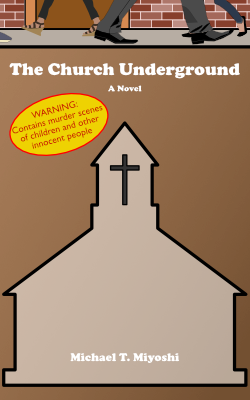
I suppose the folks who have a copy of the book or will have a copy of the book might keep it for posterity. They might save it as a possible collector’s item. One of the six copies in existence of the famous book, The Church Underground. Which is funny to think about. In reality, those six might be the only copies of the book ever printed. Which is okay. I love to write. And I love it that my books are published. I love it that anybody who wants a copy can order it and have it printed and shipped in just a short amount of time. Not that anybody will do that, but it is nice that writers like me can at least dream of a few sales here and there. Or even of just that one sale.
By the way, I like the fact that I actually do sell copies of my books now and then. Sure. The sales are neither rapid nor voluminous. But that is okay. The books are out there. I no longer just dream of having books that people can buy. I actually have books out there. Lots of books. At least lots of books ready to be printed. (Fifteen at last count and ten more available digital only.)
I know that my books are not hot sellers. At least not yet. But it might be a good thing. After all, since I just throw stuff out there, they might have a lot of errata in them. Which is okay. Since they are all self-published and print on demand books, I can just fix them. And voilà! No muss. No Fuss. No errata.
© 2024 Michael T. Miyoshi
| Share on facebook | Tweet |
|
Idiotic Idioms, Mixed Metaphors, and Yogi (Berra)-isms · 11 May 2024

I love language. It is obviously the way we communicate, whether in oral or written form. And the way we communicate can be so interesting. Especially, when we communicate so colorfully. Especially, when we use idiotic idioms, mixed metaphors, and Yogi (Berra)-isms.
I already talked a little about idiotic idioms. You know. Those silly sayings we use that are supposed to communicate something in a unique or pleasing way. Packed in like sardines. Filled to the gills. Dead as a doornail. Idioms like these have been used for a long time, but people may not know their origins or they may not have as much universality as they used to. So they might not pack quite as much punch as they used to. But we still use them. And new ones are being made up, seemingly all the time.
Another interesting way we communicate is through metaphors. Those are the turns of phrase that color our communications. They are similar to or like similes, but different. (Similes usually use the word ‘like’ in their comparisons. Life is like a box of chocolates. That is a simile used by Forrest Gump. Over and over and over again. Or maybe people just quoted the character over and over and over again. At any rate, people mix up similes and metaphors, so I thought I would throw in a simile.) Metaphors make comparisons similar to similes, but they go one step further. They say that one thing is more than just like another. They say that the one thing is the other thing. Fútbol is life! That is a metaphor used by Dani Rojas in Ted Lasso. Over and over and over again.
Mixed metaphors are slightly different than regular metaphors. They convey meaning through an equality like metaphors do, but they do so in unpredictable and silly ways. Well, sometimes they convey meaning. Usually, not the meaning we want to convey. Although people can actually use mixed metaphors to great effect. My favorite mixed metaphor is: We’ll burn that bridge when we get to it.

Think about it. Burning bridges is not something most people want to do. After all, the sense of the notion of burning bridges is that you cannot get back to where you were before. Whether that is a place (if you were taking things literally) or a job or a relationship, you do not usually want to burn bridges. So thinking about burning bridges when you get to them (whether instead of or after crossing them) is ludicrous. If you want to burn bridges before crossing them, you will obviously need to find another way to cross. If you want to burn the bridges after you cross them, I suppose you should make sure to leave behind only the people you want to thumb your nose at.
At any rate.
I like mixed metaphors, especially burning bridges, because they make people think about what you said. They wonder if they heard you right or not. Which means they are a good way to check to see if people are listening.
Which brings me to the person who had perhaps the best mixed metaphors and malapropisms (swapping one word for another, usually in a funny way, usually unintentional) or just funny quotes in history. Or at least he said enough funny stuff for people to continue to write about them. Yogi Berra was a great professional baseball player and manager. And he had a myriad of Yogi-isms. Those quotes that made you think about what he was saying. They often made those who heard the quotes wonder if they really heard what they thought he said.
“When you come to a fork in the road, take it.”
“You can observe a lot by just watching.”
“It ain’t over till it’s over.”
“If you don’t know where you are going, you might wind up someplace else.”
You can find Yogi-isms all over the internet. People are still writing about him decades after he said them. Probably because he was entertaining. Probably because they were true too. And, of course, people remember what he said because he was such a great baseball player, which gave him a forum for people to hear what he said in the first place.
Speaking of which. I am not sure where I was going, but I hope I got there.
I love language. And even though I am a native English speaker, I still wish I understood English better. After all, there will always be idiotic idioms, mixed metaphors, and Yogi-isms to both color the language and make us wonder if we really heard what we just heard.
© 2024 Michael T. Miyoshi
| Share on facebook | Tweet |
|
| Older | Newer |